India vs New Zealand Final Rules: What Happens in Case of Rain or Tie in the T20 World Cup 2026 Final? (Image Courtesy: Facebook)
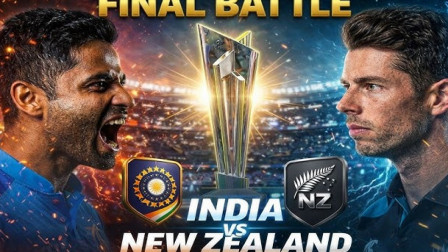
New Delhi: The T20 World Cup 2026 has now reached its finale—the India vs. New Zealand final! Starting from the group stage, Super 8, then the semi-finals, and now this last battle. The rules have changed slightly at each stage, and there are some significant changes in the playing conditions in the finals as well. Let us understand what the difference is between the rules of semi-finals and finals so that there is no confusion during the match.
The rules are the same in both semi-finals and finals – both teams will have to play at least 10 overs each (if neither team is all out in the first innings) to determine the result of the match. It means if the first team is able to play only 9.5 overs and rain comes, then the match will go to the next reserve day. If it is not possible there, then the match will be cancelled.
In the semi-finals, 90 minutes of extra time was available on the match day, but in the final it has been increased to 120 minutes (i.e. 2 hours). There are only 120 minutes of extra time on both the reserve days. That means in the final, more efforts will be made to complete the match on the same day.
In the semi-finals, the match started at 3 pm on the reserve day. But in the final the play will start from 7 pm only. Both have one thing in common – the match will start from where it stopped. Like if it stopped at 9.3 overs, then the next day it started from 9.4 overs, with the same batsman and the same bowler.
This is the biggest difference. If the reserve day was also washed out by rain in the semi-finals, then the top team would advance in the Super-8. But this will not happen in the final – if both the match and the reserve day are canceled due to rain, then both the teams will be declared joint winners. This had happened only once in the ICC Trophy – in 2002 when India and Sri Lanka were made joint winners.
If the Super Over could not be conducted in the semi-finals (due to rain or any other reason), then the top team of Super-8 would advance. But if there is a tie or not a Super Over in the final, then both teams will still be made joint winners. That means the trophy can be shared in the final under any circumstances if there is no result.




Copyright © 2026 Top Indian News